

On this page
- Quick summary
- What is topical authority in SEO?
- Why topical authority matters for organic visibility
- How pillar pages and supporting pages work together
- Map search intent before creating content
- Build depth through helpful content, not content volume
- Isolated keyword targeting versus a connected topic cluster
- Use internal links to make topic relationships clear
- Measure and refine topical coverage
- Topical authority audit checklist
- Where SEO automation can support the work
- Frequently asked questions
- Conclusion: build one coherent subject before expanding
Topical authority for SEO is the practical result of demonstrating focused expertise on a subject through useful, connected content that answers related search questions. It is not a public Google score or a guarantee of rankings. Instead, it describes how clearly your website covers a subject, serves its audience, and connects pages into a coherent resource.
Building it starts with focus, not volume. Choose a subject relevant to your customers, map the questions they ask, create pages that own those intents, and connect them with helpful internal links. Google’s people-first content guidance supports this approach by emphasizing useful, reliable information created for people.
Quick summary#

- Topical authority is demonstrated subject coverage, not an official metric or fixed score.
- Build around one focused subject with a comprehensive pillar page and distinct supporting pages.
- Match every page to a meaningful search intent instead of repeating the same keyword.
- Use descriptive, natural internal links to show relationships between pages.
- Review Search Console queries, content gaps, overlap, and user value as the cluster develops.
What is topical authority in SEO?#
Topical authority is the perceived depth and relevance a website develops when it consistently covers a subject and its related questions. A site demonstrates this through the combined quality of its pages, the clarity of its information, the relevance of its examples, and the relationships between its content.
This differs from domain authority or page authority metrics provided by third-party tools. Those scores are proprietary estimates, while topical authority is a broader strategic concept. It is also different from keyword density. Repeating a phrase more often does not prove that a page understands the reader’s problem or covers the subject well.
There is no universal article count that creates topical authority, and no single threshold confirms that you have achieved it. A smaller site with focused, genuinely useful coverage can be more relevant for a specific audience than a large site publishing disconnected articles across unrelated subjects.
Why topical authority matters for organic visibility#

Focused coverage gives readers a clearer path through your website. Someone may begin with a broad educational question, move to a comparison page, and then reach a service or product page when ready to act. Each page supports a different stage without forcing one article to answer every possible question.
It also gives search engines more context about how your pages relate. A pillar page can explain the broad subject, while supporting pages clarify specific subtopics. This structure can make your site easier to interpret, although it does not guarantee rankings, traffic, or inclusion in an AI-generated answer.
Google Search Essentials emphasizes helpful content and using the words people search for in prominent, understandable locations. The goal is not to manufacture a large content footprint. It is to make your expertise easy for people to find, use, and evaluate.
How pillar pages and supporting pages work together#
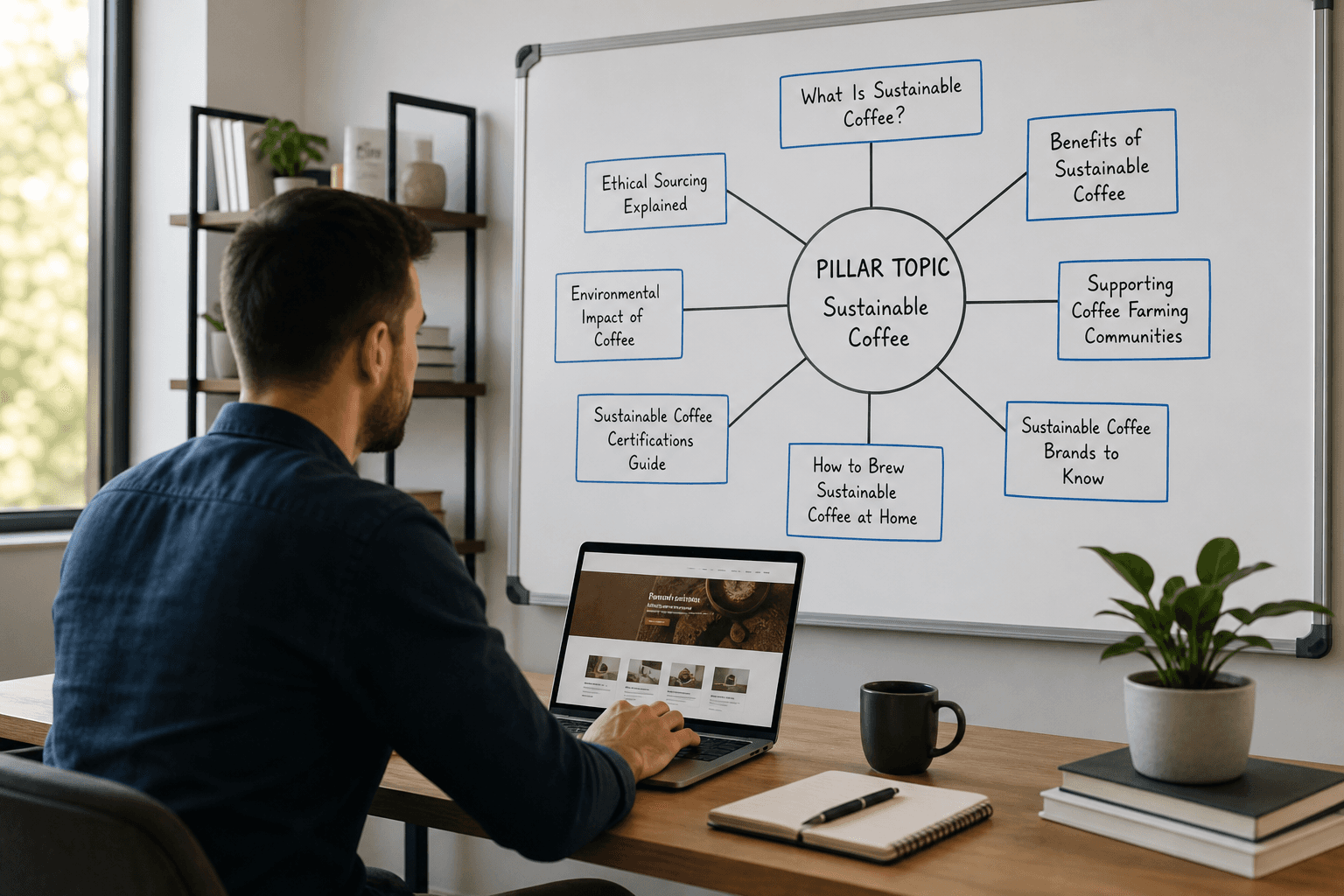
A topic cluster normally has three connected parts:
- Pillar page: A broad, substantial page that introduces the main subject and directs readers to relevant details.
- Supporting pages: Focused pages that answer distinct questions, tasks, comparisons, or subtopics.
- Internal-link network: Contextual links that connect the pillar to supporting pages and connect related pages where the relationship helps the reader.
For example, a landscaping company might build a cluster around lawn renovation. Its pillar page could explain the overall service, while supporting pages address renovation timing, drainage problems, seed versus sod, preparation steps, and questions to ask before hiring a contractor. These pages should provide independent value rather than restating the same introduction.
This structure separates broad education from specific intent. For a deeper explanation of page roles and relationships, see this overview of topic clustering.
Map search intent before creating content#
Before outlining pages, list the questions your audience asks and group them by purpose:
- Informational: The reader wants to understand a topic, problem, term, or process.
- Comparison: The reader is weighing options, approaches, providers, or products.
- Commercial: The reader is evaluating whether a solution fits their needs.
- Transactional: The reader is ready to request, purchase, book, or contact someone.
Assign each important question to the page best suited to answer it. Similar keywords may belong on one page if they represent the same need. Separate pages make sense when the questions require different explanations, examples, formats, or next steps.
For instance, “how does commercial cleaning work?” and “commercial cleaning checklist” may overlap, but they can serve different needs. The first might require an explanatory service overview. The second may need a practical checklist. Base the decision on reader intent, not a desire to create more URLs.
Build depth through helpful content, not content volume#
Every page in a cluster should earn its place. It should answer a real question, use language the audience understands, add relevant experience or evidence, and give the reader a sensible next step. Thin pages that exist only to target minor keyword variations can make a cluster harder to navigate and maintain.
Useful content is specific. Explain decisions, constraints, tradeoffs, and common mistakes. Where appropriate, include first-hand observations, original examples, named sources, clear definitions, or practical instructions. Do not claim experience, results, or local knowledge that your business cannot support.
Content optimization helps align a page with search intent, headings, internal links, media, accessibility, and technical quality. It should improve the usefulness of each page, not simply add keywords.
Isolated keyword targeting versus a connected topic cluster#
| Approach | Isolated keyword targeting | Connected topic cluster |
|---|---|---|
| Planning | Starts with individual phrases. | Starts with a subject, audience, and related intents. |
| Page purpose | Several pages may target similar questions. | Each page has a distinct job and search intent. |
| Relationships | Pages may sit disconnected in the site. | Pillar and supporting pages are intentionally related. |
| Internal links | Links are added inconsistently or late. | Links guide readers through relevant information. |
| Measurement | Focuses mainly on individual rankings. | Reviews coverage, queries, overlap, engagement, and gaps. |
A cluster is not a guaranteed ranking formula or a requirement to publish a predetermined number of articles. Its value comes from the relevance and usefulness of the whole system. A small, coherent cluster is often a better starting point than a large collection of loosely related posts.
Use internal links to make topic relationships clear#
Link the pillar page to supporting pages that expand important points. Link supporting pages back to the pillar when readers need broader context, and connect sibling pages when one naturally helps explain another. The link should make sense in the sentence, not appear as a forced list of keywords.
Use descriptive anchor text that tells readers what they will find. “Lawn renovation preparation steps” is more informative than “read more.” Google explains that descriptive anchor text can help people and Google understand linked pages, and that important pages should be linked from elsewhere on the site.
Check that links are crawlable, visible, and placed where they help the reader make progress. Avoid linking every page to every other page. A smaller number of relevant connections creates a clearer structure than a dense web of repetitive links.
Measure and refine topical coverage#
Topical authority is not measured by one official score, so review several practical signals. Look for relevant queries appearing in Search Console, pages receiving impressions for related questions, content attracting the wrong intent, and topics your audience asks about that your site does not answer.
Also check for overlap. If two pages compete for nearly the same question, decide whether to combine them, differentiate their purposes, or adjust their links and headings. Search Console data can reveal emerging queries and opportunities, but combine it with customer conversations, sales questions, support requests, and subject-matter judgment.
Refinement may involve improving an existing page rather than publishing a new one. Add a missing explanation, clarify the audience, strengthen evidence, improve navigation, or link the page to the right part of the cluster. Consistent review is more useful than treating publication volume as the primary goal.
Topical authority audit checklist#
- Subject focus: Can you describe the cluster’s central subject in one clear sentence?
- Audience relevance: Does the subject connect to a real customer need, service, product, or area of expertise?
- Intent ownership: Does each page answer a distinct question or decision?
- Pillar quality: Does the broad page explain the subject clearly and direct readers to useful details?
- Supporting-page gaps: Which important questions remain unanswered?
- Page usefulness: Could each supporting page help a reader if found directly?
- Evidence and expertise: Are claims accurate, appropriately supported, and specific without being overstated?
- Internal links: Do descriptive, natural links connect pages in ways that help readers?
- Accessibility and crawlability: Can people and search engines reach important pages easily?
- Measurement: Are you reviewing relevant queries, overlap, gaps, and quality improvements rather than chasing one score?
Where SEO automation can support the work#
Building topical authority involves repeated operational tasks: researching questions, grouping topics, planning page roles, drafting content, optimizing pages, adding internal links, and publishing updates. Automation can reduce the manual workload, but it does not replace decisions about accuracy, audience needs, brand standards, or whether a page deserves to exist.
UpliftAI positions its platform as an SEO execution engine that supports keyword discovery, topic clustering, writing, content optimization, internal linking, and publishing. Its supplied capabilities also include Google Search Console integration and CMS support for WordPress, Webflow, Shopify, and Framer. Human review remains important for checking facts, examples, tone, originality, and business relevance.
A sensible workflow uses automation for repeatable discovery and production tasks, followed by editorial review before publication. Check whether proposed pages cover distinct intents, whether links are genuinely useful, and whether content reflects what customers need.
Frequently asked questions#
Is topical authority an official Google ranking score?#
No. Topical authority is a strategic description of focused, connected subject coverage, not an official Google score. Tools may offer related estimates, but those measurements are not a universal standard.
How many articles do you need to build topical authority?#
There is no reliable fixed number. The right scope depends on the subject, audience, business expertise, and meaningful questions that need answers. Start with important intents and expand when there is a genuine content gap.
Can a small business build topical authority with a limited website?#
Yes. A small business can begin with one audience-relevant subject, a strong pillar page, and a manageable set of supporting pages. Narrow focus, accurate information, clear internal links, and useful detail can be more valuable than covering unrelated subjects.
Can AI-generated content help build topical authority?#
AI can assist with research organization, outlines, drafts, optimization, and publishing workflows. It contributes only when the final content is accurate, useful, distinct, and reviewed by someone who understands the audience and subject.
Conclusion: build one coherent subject before expanding#
Building topical authority for SEO means making your expertise clear through connected, intent-matching content. Start with one subject that matters to your audience, define the questions surrounding it, improve or create a useful pillar page, and add supporting pages only when they serve distinct needs.
Then connect the pages with descriptive internal links, review the cluster for overlap and gaps, and use Search Console alongside customer insight to refine it. The strongest cluster is not the largest one. It is the one that helps people understand, compare, and act with less confusion.
If you want help reducing the manual work across research, content creation, optimization, internal linking, and publishing, explore UpliftAI and evaluate whether its execution workflow fits your business.