
On this page
- Quick summary
- What Is SERP Feature Tracking?
- Which SERP Features Should You Monitor?
- Choose Keywords and Locations That Produce Useful Signals
- A Practical Measurement Framework for SERP Visibility
- Google SERP Features and AI Answers Are Different Measurements
- Ecommerce Tracking: Shopping Results and Product Visibility
- What to Do When a SERP Feature Changes
- Troubleshooting Checklist for Sudden Visibility Loss
- How to Evaluate a SERP Feature Tracking Tool or Workflow
- Where SEO Execution Fits After You Find a Visibility Gap
- FAQ
- Conclusion: Track the Search Surface That Matters to Your Business
Traditional keyword rankings show where a page appears among blue links. They do not show whether your business owns a featured snippet, appears in a local pack, is listed in shopping results, or is cited in an AI-generated answer. SERP feature tracking fills that gap by recording the search surfaces that appear for important queries and whether your business is visible in them.
For a small business, the goal is not to track every possible feature. It is to monitor the features connected to your customers, locations, products, and commercial priorities, then use changes in visibility to decide what to investigate or improve.
Quick summary#

- Track features that match your search intent, such as local packs for service businesses or shopping results for ecommerce stores.
- Record presence, ownership, prominence, competitors, location, device, and change over time.
- Keep Google SERP feature tracking separate from visibility in ChatGPT, Gemini, Claude, Perplexity, and other AI answers.
- When a feature disappears, check intent, rankings, content, technical access, structured data, local information, and tracking settings before changing strategy.
What Is SERP Feature Tracking?#
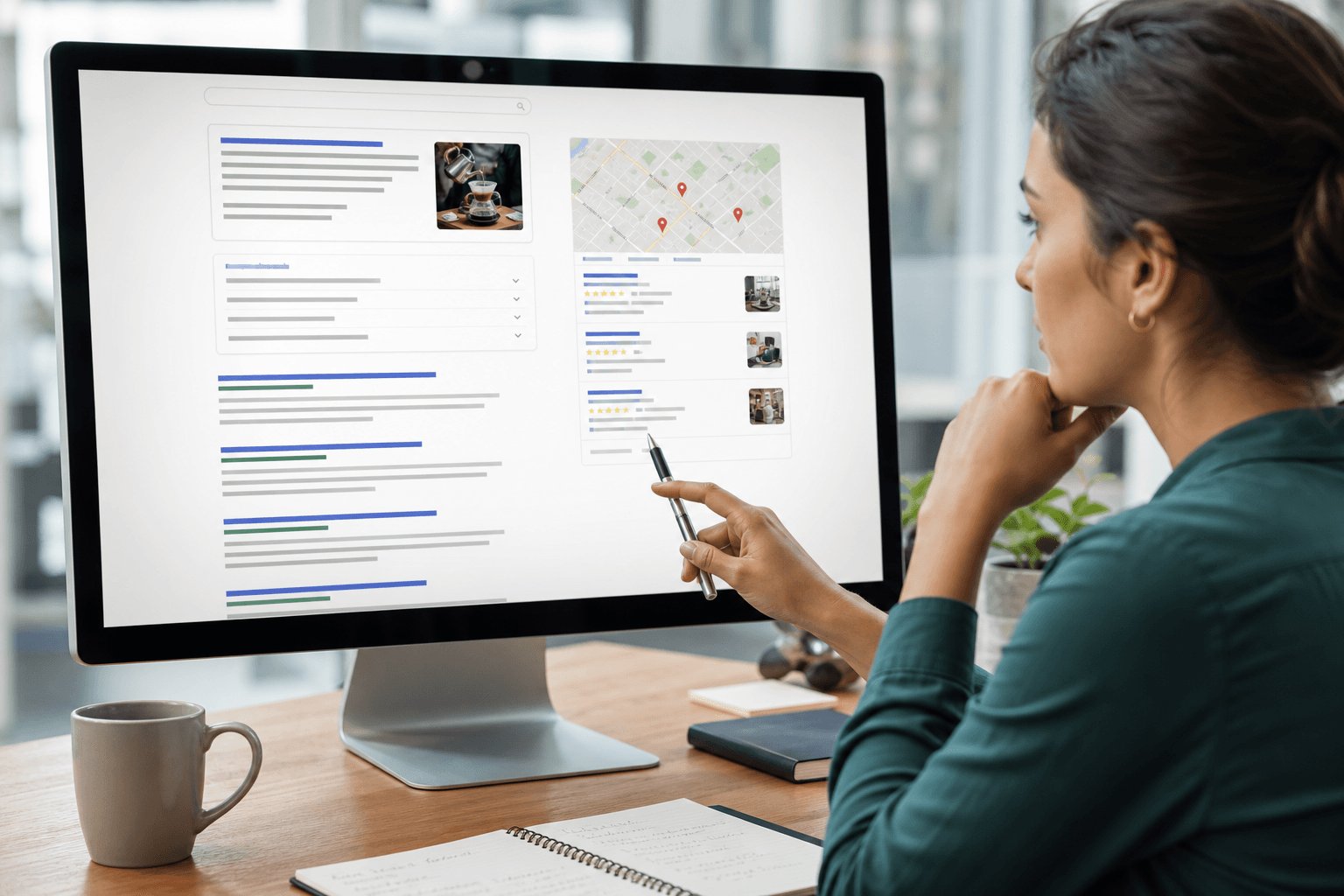
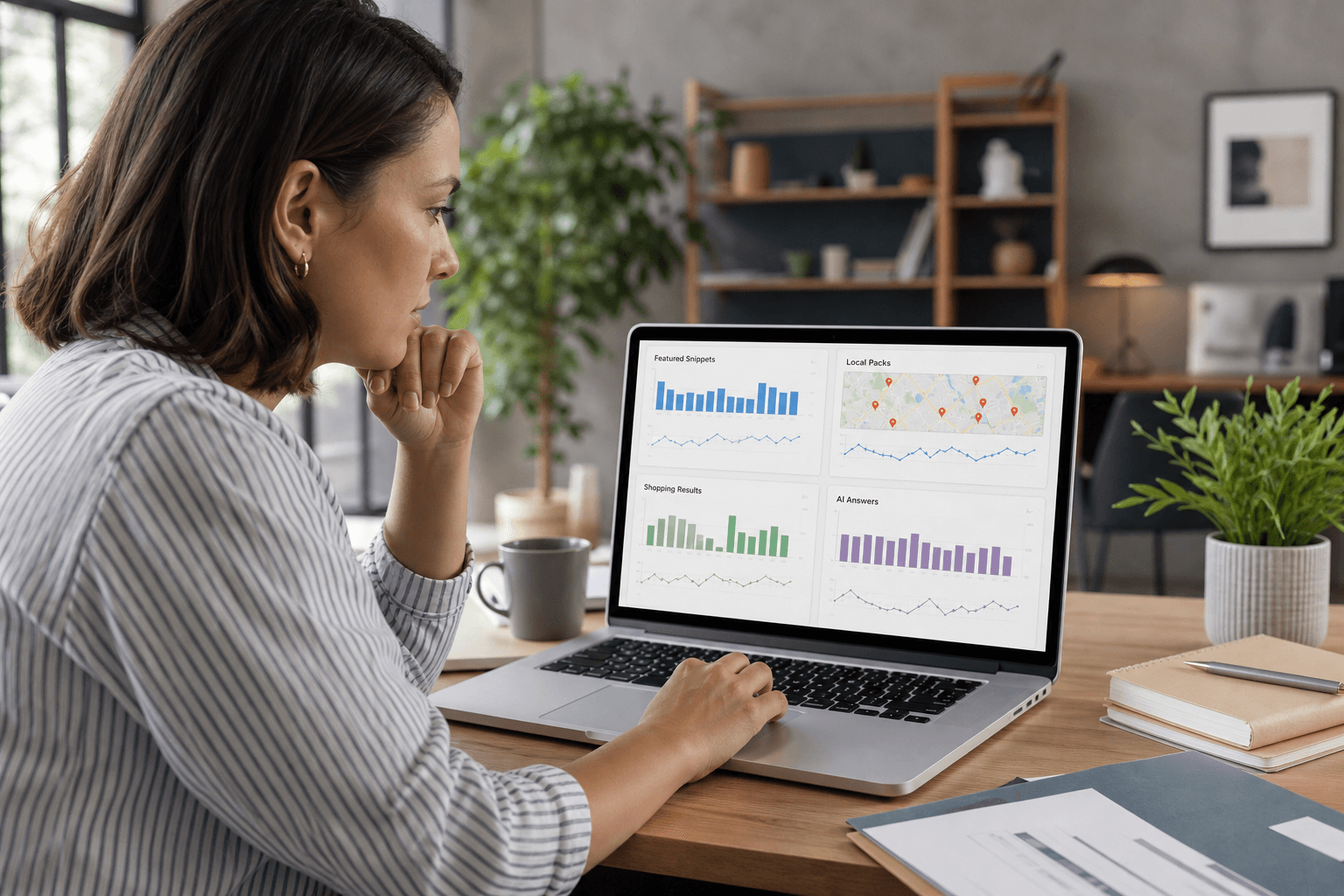
SERP feature tracking is the process of monitoring non-standard search results that appear alongside or above traditional organic listings. Depending on the query, these may include featured snippets, People Also Ask questions, local packs, image packs, video carousels, knowledge panels, shopping results, and AI Overviews.
Standard rank tracking answers a narrow question: where does your page appear for a keyword? SERP feature tracking asks a broader question: what does the results page show, who owns each visible element, and where does your business appear?
| What to measure | Traditional rank tracking | SERP feature tracking |
|---|---|---|
| Blue-link position | Primary measurement | Useful context |
| Feature presence | Usually not recorded | Was a local pack, snippet, or other feature shown? |
| Ownership | Which URL ranks? | Which business, page, or competitor owns the feature? |
| Prominence | Position in organic listings | Placement, size, and visibility of the feature |
| Change over time | Position gains or losses | Features appearing, disappearing, or changing owners |
A complete workflow can combine rank tracking with feature monitoring, but the two measurements should not be treated as interchangeable. A page can hold a strong organic position without owning a featured snippet, while a business can appear in a local pack even when its website does not rank first organically.
Which SERP Features Should You Monitor?#

Choose features based on the questions your customers ask and the action you want them to take. A local contractor, online retailer, and professional service firm will not need the same tracking set.
Featured snippets and People Also Ask#
Featured snippets can place a page above standard organic results for an informational query. Track whether a competitor owns the answer, which page Google displays, and whether your content addresses the question directly and accurately.
People Also Ask results reveal related questions that searchers explore. Monitor questions connected to priority topics, especially when they expose gaps in service explanations, buying guidance, or educational content.
Local packs and map-related visibility#
Local packs matter when searchers are choosing a nearby provider, visiting a location, or comparing services in a defined area. Track the exact service query, search location, device, businesses shown, review context, and whether your profile or website is visible.
Local visibility can vary by neighborhood, distance, device, and query wording. A business that appears in one city-center search may not appear from another part of the same service area, so one check is not a reliable measurement.
Video, image, and knowledge features#
Video carousels and image packs matter when customers need demonstrations, inspiration, examples, or visual proof. Track whether your media appears, which page or channel is associated with it, and whether the content matches the search intent.
Knowledge panels can support branded visibility, but they are not the same as a ranking a business can directly control. Monitor the information displayed, look for factual errors, and distinguish visibility from ownership.
Shopping results and other query-dependent features#
Retail and product businesses should monitor shopping results, product listings, reviews, and other commercial result types. Track them for product, category, comparison, and brand queries rather than assuming general informational rankings reflect product visibility.
Choose Keywords and Locations That Produce Useful Signals#
Start with a focused keyword set rather than every phrase related to your business. Include queries from these groups:
- Commercial service queries: service names, provider types, and service-plus-location searches.
- Questions: who, what, how, when, and whether queries that may trigger snippets or People Also Ask.
- Local-intent searches: “near me,” city, neighborhood, and “open now” variations where relevant.
- Branded searches: your business name, products, services, and common misspellings.
- Product and comparison searches: product names, categories, specifications, alternatives, and buying questions.
Prioritize terms connected to revenue, high-value services, important products, and recurring customer questions. A smaller list of meaningful queries usually produces better decisions than a large list nobody reviews.
For local businesses, define the location and device before comparing results. Use consistent city, neighborhood, postal-code, or map-grid points where possible, and record whether the search was performed on desktop or mobile.
A Practical Measurement Framework for SERP Visibility#
For every tracked query, record enough information to explain a change later:
- Query and intent: the exact phrase and whether it is informational, local, branded, commercial, or transactional.
- Feature presence: which search features appeared.
- Ownership: whether your business, page, product, or competitor appeared.
- Prominence: position, placement, size, or visibility.
- Displayed URL: the page Google or another system selected.
- Competitors: businesses, domains, products, or publishers appearing instead.
- Context: date, location, device, language, and search engine.
- Change over time: new appearance, loss, ownership change, or movement.
Turn the data into decisions by asking what changed and what action could influence it. A feature loss accompanied by a ranking decline suggests a different investigation from a feature loss where your blue-link position is unchanged.
Google SERP Features and AI Answers Are Different Measurements#
AI Overviews appear within some Google searches, but visibility in an AI-generated answer should still be measured separately from conventional SERP features. A cited source, linked result, organic ranking, and local listing represent different forms of visibility.
The same distinction applies to chatbot answers from ChatGPT, Gemini, Claude, and Perplexity. Monitor prompts, country or region, date, answer wording, cited sources, and whether your business is mentioned or linked. A business can be referenced by an AI system without holding a conventional Google ranking.
Use AI visibility tracking as a complementary measurement layer, not as proof of a Google ranking or guaranteed traffic source.
Ecommerce Tracking: Shopping Results and Product Visibility#
For ecommerce brands, SERP feature tracking should include shopping answers because product visibility increasingly depends on verifiable facts. Monitor price, currency, availability, specifications, compatibility, shipping information, variants, and reviews.
These details should be explicit on the page and consistent with structured product data. Structured data can help systems interpret a product, but it does not guarantee a shopping result, rich result, featured placement, or AI citation.
What to Do When a SERP Feature Changes#
A change is a signal to investigate, not an instruction to rewrite a page immediately. Match the response to the feature:
- Featured snippet lost: compare the winning answer and improve directness and accuracy.
- People Also Ask changes: review related questions and add useful answers where your expertise supports them.
- Local pack visibility falls: check profile accuracy, categories, reviews, local relevance, and search location.
- Shopping visibility changes: verify price, availability, product attributes, reviews, and structured data.
- Video or image visibility falls: check relevance, indexing, titles, descriptions, and accessibility.
- AI answer mentions change: repeat the same prompts and context, then review source coverage and factual consistency.
Troubleshooting Checklist for Sudden Visibility Loss#
- Repeat the search using the same keyword, location, device, language, and date range.
- Check whether search intent or the result layout has changed.
- Compare the blue-link position with the previous observation.
- Confirm that the relevant page is accessible, indexable, canonical, and not blocked.
- Review content freshness, factual accuracy, page experience, and competitor improvements.
- Check structured data against the visible page, particularly for price, stock, product details, and local information.
- For local results, review profile edits, categories, hours, service areas, reviews, and location differences.
- Confirm that the tracking system has not changed its feature definitions, device settings, or location source.
How to Evaluate a SERP Feature Tracking Tool or Workflow#
Before buying a SERP feature tracker, check whether it supports the decisions your business needs to make. Look for:
- Coverage of features relevant to your industry and query types.
- Keyword, location, language, and device controls.
- Historical records showing when features appeared, disappeared, or changed owner.
- Competitor comparisons and the URL or business displayed.
- Screenshots, result evidence, or another way to validate surprising changes.
- Useful alerts rather than noise from every fluctuation.
- Exports and reporting that connect visibility changes to practical actions.
- Separate reporting for Google features, AI Overviews, and chatbot visibility.
A lightweight manual process can be enough for a small set of high-value searches. Automation becomes more useful when you manage many locations, products, devices, or queries.
Where SEO Execution Fits After You Find a Visibility Gap#
Measurement only creates value when it leads to an informed improvement. UpliftAI is positioned as an AI-powered SEO execution platform that supports keyword research, content optimization, local SEO, AI-search visibility, and automated publishing. Its stated workflow is designed to research, write, optimize, and publish content rather than operate only as an analytics dashboard.
That makes execution relevant after a tracking review identifies a content or local-visibility opportunity. It does not mean the platform should be assumed to provide a dedicated SERP feature tracking dashboard. Verify the monitoring capabilities you need before choosing any platform.
FAQ#
How often should a small business check SERP features?#
Check high-value commercial and local queries weekly or whenever you make a significant SEO, product, or profile change. Monthly reviews may be sufficient for lower-priority informational terms.
Should local businesses track SERP features by city or neighborhood?#
Yes, when location strongly affects the result. Track consistent locations that represent your service area and record the device used.
Are AI Overviews part of traditional SERP feature tracking?#
They are part of the broader search-visibility picture, but they should be reported separately because their presentation and citation behavior differ.
What is the difference between SERP feature tracking and AI-visibility tracking?#
SERP feature tracking observes features on a search results page. AI-visibility tracking measures whether an AI-generated answer mentions, cites, or links to your business or content.
Can structured data guarantee a shopping result or featured snippet?#
No. Structured data helps systems interpret eligible information, but it does not guarantee placement. Relevance, accessibility, accuracy, and usefulness still matter.
Conclusion: Track the Search Surface That Matters to Your Business#
SERP feature tracking is most useful when it begins with business-critical queries rather than an exhaustive keyword list. Choose features connected to your customers, record presence and ownership alongside traditional rankings, and keep location, device, competitors, and dates consistent.
When visibility changes, investigate intent, rankings, content, technical access, structured data, local information, competitors, and tracking settings before reacting. Treat Google SERP features and AI-generated answers as related but distinct measurements.
UpliftAI supports businesses with AI-powered keyword research, content optimization, local SEO, AI-search visibility, and automated publishing for teams that want SEO execution without managing every step manually.