

On this page
- What automated backlink building methods include
- Why SEO automation needs a quality-first process
- How an automated backlink workflow works
- 13 white-hat automated backlink building methods
- How to keep automated outreach safe
- Manual, automated, or hybrid backlink building?
- Examples for local service businesses
- How UpliftAI supports the workflow
- Launch checklist for your first campaign
- Common mistakes and practical fixes
- FAQ about automated backlink building methods
- Start a safer automated backlink workflow
Last updated: September 2026
Key takeaway:Automated backlink building methods use repeatable software-assisted workflows to find relevant prospects, personalize outreach, promote useful assets, and monitor placements while people make quality decisions. For SMBs, the safest approach combines AI-powered SEO with human review, editorial value, and a steady publishing and promotion cadence.
Backlinks can support organic visibility, but earning them manually often competes with customer service, sales, and daily operations. The practical goal is not to generate the largest possible number of links; it is to create a reliable process for identifying relevant opportunities and offering something worth citing.
This guide explains what SEO automation can responsibly handle, which tasks need human judgment, and how local service brands and other U.S. SMBs can build a white-hat workflow without relying on spam, purchased links, or generic mass outreach.
What automated backlink building methods include#
Automated backlink building methods organize repetitive activities such as prospect discovery, contact enrichment, message drafting, follow-up scheduling, mention monitoring, and placement tracking. Automation can make these tasks more consistent, but it cannot make an irrelevant website or weak asset valuable to readers.
Tasks that automation can support#
- Finding pages, publications, associations, and partners with topical or local relevance.
- Organizing prospects by audience, location, topic, and editorial fit.
- Drafting personalized outreach from approved facts, expert notes, and brand guidance.
- Monitoring brand mentions, broken references, published links, and follow-up dates.
- Connecting link acquisition activity with content planning and internal linking.
Decisions that should remain human#
A person should approve target sites, sensitive claims, final pitches, partnerships, and any request involving reputation or compliance. Human review also helps remove prospects with poor topical fit, excessive advertising, copied content, or an editorial standard that does not suit the brand.
Why SEO automation needs a quality-first process#
AI-powered SEO can increase production and coordination, but scale magnifies both useful work and poor decisions. A large list of generic emails does not replace a relevant asset, a credible subject-matter expert, or a reason for another publisher to help its readers.
A safer process treats each potential link as an editorial recommendation. The destination should improve the receiving page, the source should be relevant, and the outreach should explain the reader benefit rather than promise an exchange or guaranteed placement.
How an automated backlink workflow works#
- Choose a useful destination: Start with a guide, calculator, checklist, original explanation, local resource, or other asset that answers a real question.
- Define the audience: Identify the people and organizations most likely to use or cite the asset.
- Find relevant prospects: Look for resource pages, articles, newsletters, associations, publications, partners, and community organizations with a clear content fit.
- Qualify each opportunity: Review topical relevance, audience, publishing activity, editorial quality, and whether the proposed link would help readers.
- Draft a specific pitch: Reference the page, identify a useful gap, and explain what the asset adds. Use AI to accelerate drafting, not to remove judgment.
- Review before sending: Check facts, tone, personalization, recipient fit, and any claims that require approval.
- Track the result: Record replies, live placements, referring domains, destination pages, and assisted business outcomes.
- Improve the asset: Use recurring questions and successful placements to guide future content and updates.
13 white-hat automated backlink building methods#
The following approaches can be organized with SEO automation while keeping the value exchange and final quality checks visible.
1. Digital PR and data-led stories#
Prepare a useful data brief, seasonal guide, or expert explanation and organize outreach by publication type, topic, and region. AI can create pitch variations, while a human confirms that the data and news angle are accurate.
2. Expert quote responses#
Maintain approved subject-matter notes, biographies, and brand facts so an expert can respond quickly to relevant journalist requests. Review every answer for originality, accuracy, and a genuine fit before submission.
3. Unlinked mention reclamation#
Monitor mentions of the business, products, services, and experts. When a publisher has already referenced the brand without a link, send a concise request pointing to the most useful supporting page.
4. Resource page outreach#
Identify curated pages that genuinely serve the same audience, then suggest a specific checklist, guide, or tool that fills an apparent gap. Avoid treating every directory or “best of” page as a worthwhile target.
5. Linkable assets#
Build resources people can use or cite, such as planning templates, calculators, original visual explanations, and practical checklists. Automate distribution research and reminders, but let the audience need determine the asset.
6. Local citation maintenance#
Keep business name, address, phone, categories, services, and profile information consistent across reputable directories and local platforms. Citations are not the same as editorial backlinks, but accurate local information supports discoverability and entity clarity.
7. Partner and vendor spotlights#
Document real relationships with suppliers, venues, associations, and complementary providers. Co-created stories can earn relevant mentions when they provide useful context rather than creating a pattern of artificial reciprocal links.
8. Broken-link outreach#
Find relevant pages containing dead references and suggest a current replacement only when the proposed resource genuinely serves the same purpose. Include enough context for the editor to verify the change easily.
9. Community initiatives#
Coordinate legitimate scholarships, grants, educational resources, or community projects with clear eligibility and public information. The initiative must have real value; creating a program solely to obtain links is not a durable strategy.
10. Visual asset promotion#
Offer accurate charts, diagrams, and visual explainers with clear attribution guidance. Monitor legitimate uses and request a linked credit when a publisher has used the asset without a reference.
11. Podcast and webinar participation#
Find shows and events whose audiences match the business, then organize pitches around useful expertise. Scheduling, speaker information, and follow-ups can be automated, while the appearance and any show-note link remain editorial decisions.
12. Authentic testimonials#
Provide truthful feedback to vendors or partners when requested. A published testimonial may include a business reference, but never require a link, exaggerate results, or manufacture a relationship for placement.
13. Journalist request platforms#
Centralize approved expert facts and monitor relevant requests so a business can respond promptly. AI can help shape a concise draft, but the expert or an authorized reviewer should verify every statement.
How to keep automated outreach safe#
Prioritize relevance over volume#
A small list of well-matched prospects is more useful than a large database assembled without context. Score opportunities by audience fit, page relevance, editorial quality, and the usefulness of the proposed destination.
Use review gates#
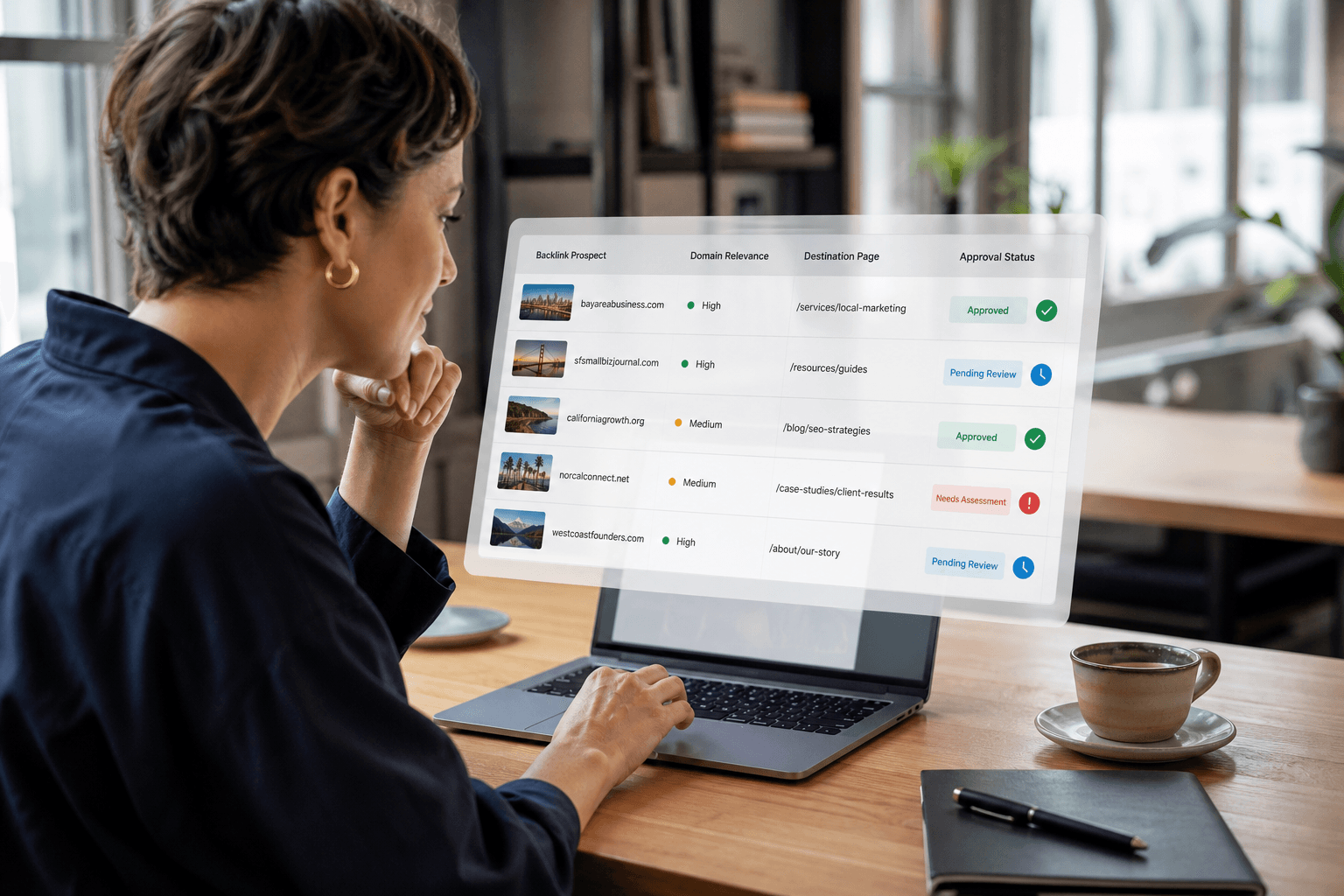
Set approval points before a prospect enters a sequence, before a message is sent, and before a placement is reported as successful. These gates protect brand voice and reduce the chance of sending inaccurate or inappropriate outreach.
Avoid manipulative patterns#
Do not buy links intended to pass ranking signals, spin content, publish irrelevant guest posts, or exchange links as an automatic condition. Steady, useful promotion is safer than sudden bursts of low-quality placements.
Track business-relevant signals#
Monitor referring domains, relevant linking pages, destination-page impressions, clicks, inquiries, and assisted conversions where available. Link counts alone cannot show whether the activity is reaching the right audience.
Manual, automated, or hybrid backlink building?#
| Approach | Strength | Limitation | Best fit |
|---|---|---|---|
| Manual | Deep research and relationship control | Slow and difficult to maintain consistently | High-stakes PR and bespoke partnerships |
| Automated | Repeatable prospecting, drafting, reminders, and tracking | Can become generic without quality controls | Organizing recurring SMB promotion tasks |
| Hybrid | Combines operational scale with human judgment | Requires documented review rules | Most local and mid-market businesses |
Examples for local service businesses#
Catering and food service#
A catering company could create an event headcount worksheet and venue-planning checklist, then identify relevant venue, event, and community pages. The workflow can organize prospects and follow-ups, while the company reviews every suggestion for audience fit.
Commercial cleaning#
A commercial cleaner might publish an office cleaning frequency planner or facilities checklist. Outreach can focus on property management publications, business associations, and local resource pages where the information helps facility teams make decisions.
Real estate#
A brokerage could develop a move-in toolkit for people relocating to the markets it serves. Potential partners might include community organizations, local businesses, and relevant housing resources, provided the proposed link adds practical value.

How UpliftAI supports the workflow#
UpliftAI is an AI-powered SEO execution platform that coordinates research, strategy, writing, optimization, publishing, internal linking, and backlink workflow tasks. Its multi-agent system includes Researcher, Strategist, Writer, Optimizer, and Publisher roles, helping businesses turn approved plans into recurring content operations.
The platform supports WordPress, Webflow, Shopify, and Framer integrations and uses Google Search Console data to inform content decisions. Teams can review how the multi-agent system is structured on the Multi-Agent SEO Brain page before deciding which parts of their process to automate.
Launch checklist for your first campaign#
- Select one existing asset that answers a specific audience question.
- Write down the asset’s audience, evidence, use cases, and strongest differentiator.
- Build a short prospect list based on relevance rather than domain count.
- Create two or three message angles tied to the recipient’s actual page.
- Set a human approval step before sending and before recording a placement.
- Use a restrained follow-up schedule and stop when the recipient declines.
- Review live links and business signals, then update the asset based on feedback.
Common mistakes and practical fixes#
- Generic outreach: Reference the recipient’s page and explain the specific reader benefit.
- Weak assets: Replace broad promotional copy with a tool, template, checklist, or well-supported explanation.
- Ignoring local relevance: Include appropriate community, association, and service-area opportunities without forcing location references.
- Counting every directory as a backlink: Separate citations, editorial links, partner references, and other link types in reporting.
- No review process: Require human approval for targets, claims, messages, and sensitive outreach.

FAQ about automated backlink building methods#
Can I automate link building without risking search penalties?#
You can automate research, organization, drafting, reminders, and monitoring while keeping quality decisions human. Avoid paid link schemes, irrelevant mass outreach, spun content, and any tactic designed to manipulate rankings rather than help readers.
Are local citations the same as backlinks?#
No. A citation usually records business details on a directory or local platform, while a backlink is a hyperlink from another page to your site. Both can support visibility in different ways, so they should be tracked separately.
What should an SMB measure?#
Track relevant referring domains, linking-page quality, destination-page impressions and clicks, referral visits, inquiries, and assisted conversions where the data is available. Also review whether the links reach the audience and topics the campaign was designed to serve.
Which tasks should AI handle in a backlink campaign?#
AI can help discover prospects, organize research, draft variations, summarize pages, schedule reminders, and identify mentions. People should approve target quality, factual claims, brand-sensitive messages, and the final decision to pursue an opportunity.
Which CMS platforms does UpliftAI support?#
UpliftAI supports WordPress, Webflow, Shopify, and Framer. Its broader workflow covers research, content production, optimization, publishing, internal linking, and backlink operations.
Start a safer automated backlink workflow#
Effective automated backlink building methods are not about putting link acquisition on autopilot without oversight. They combine useful assets, relevant prospects, thoughtful outreach, measurable follow-through, and human review so SEO automation supports long-term visibility.
To see how UpliftAI can coordinate content and promotion while your team remains in control, visit the UpliftAI SEO automation platform.