
On this page
- Quick summary
- What automated backlink building actually means
- What to automate and what to control
- Compare three backlink-building approaches
- How to evaluate a backlink opportunity
- A controlled automated backlink-building workflow
- Set goals using referring domains and the link gap
- Risks and red flags in automated link building
- Checklist for choosing automated backlink-building software
- Where UpliftAI fits in the workflow
- Frequently asked questions
- Conclusion: automate the process, not the judgment
Automated backlink building works best as a controlled workflow, not a machine for producing bulk links. You can automate repetitive tasks such as finding mentions, discovering prospects, organizing research, drafting outreach, and monitoring links. The decisions that determine quality still need careful review: relevance, audience value, editorial legitimacy, destination-page fit, and the reason a site would link to you.
That distinction matters because automated link creation intended mainly to manipulate rankings can create search-engine risk. The goal is not to collect the largest possible number of links. It is to earn useful references from relevant websites and direct them to pages that genuinely help the audience.
Quick summary#

- Automate discovery, research, prioritization, drafting, follow-up, and backlink monitoring.
- Keep human control over relevance, editorial context, destination pages, anchor wording, and final approval.
- Judge opportunities by topical fit, audience usefulness, page context, and referring-site credibility.
- Measure referring domains and page-level competitive gaps instead of chasing arbitrary backlink totals.
- Reject tools that promise guaranteed quantities, hide their sources, or rely on unrelated placements.
What automated backlink building actually means#
Automated backlink building uses software, workflows, or AI to reduce the manual work involved in earning links from other websites. A useful system might scan for existing business mentions, identify sites covering your topic, explain why each prospect is relevant, suggest a suitable page to promote, and track whether outreach produces a live link.
That is different from automatically creating pages, comments, directory entries, or network links at scale simply to pass ranking signals. Google’s spam policies identify automated programs or services that create links for ranking manipulation as practices to avoid. Google’s search spam guidance is the appropriate reference when assessing a tactic’s intent and implementation.
A practical rule is simple: automate the administration around a legitimate recommendation, not the manufacture of artificial recommendations. If a link would have no audience, editorial reason, or useful context without its SEO value, it is a weak candidate for automation.
What to automate and what to control#

| Task | Good automation candidate | Control to retain |
|---|---|---|
| Link and mention discovery | Scan existing references, unlinked mentions, and competitor pages | Verify that the source is genuine and relevant |
| Prospect research | Group sites by topic, location, audience, and page type | Confirm the site is credible, active, and appropriate |
| Prioritization | Rank opportunities by relevance, context, and potential value | Reject prospects that are merely high-metric or unrelated |
| Outreach drafting | Prepare personalized drafts and follow-up reminders | Check accuracy, tone, personalization, and legitimacy |
| Placement and destination | Recommend a relevant page and track status | Approve the final page, context, anchor, and placement |
| Monitoring | Alert you when links appear, change, or disappear | Review whether the link remains useful |
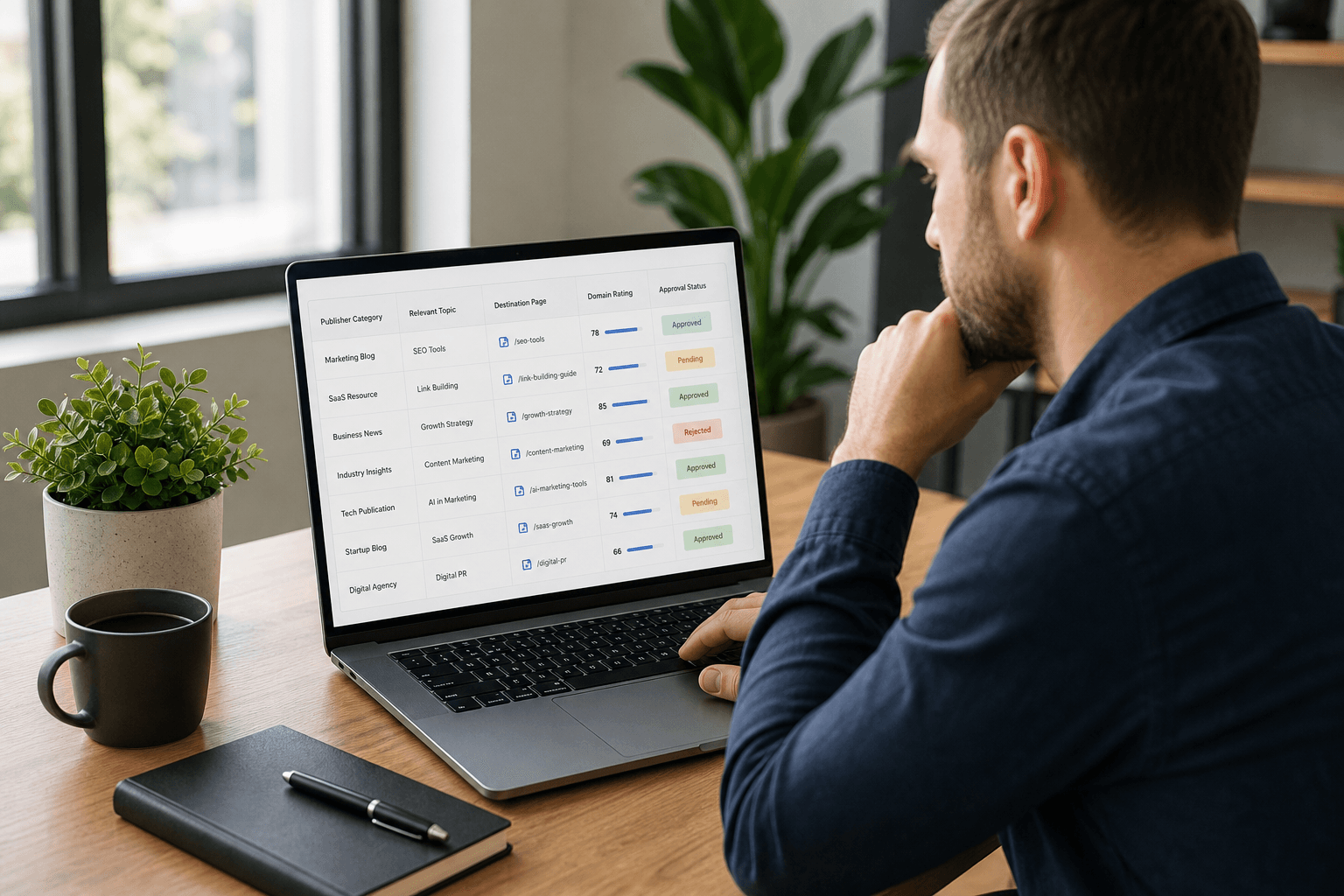
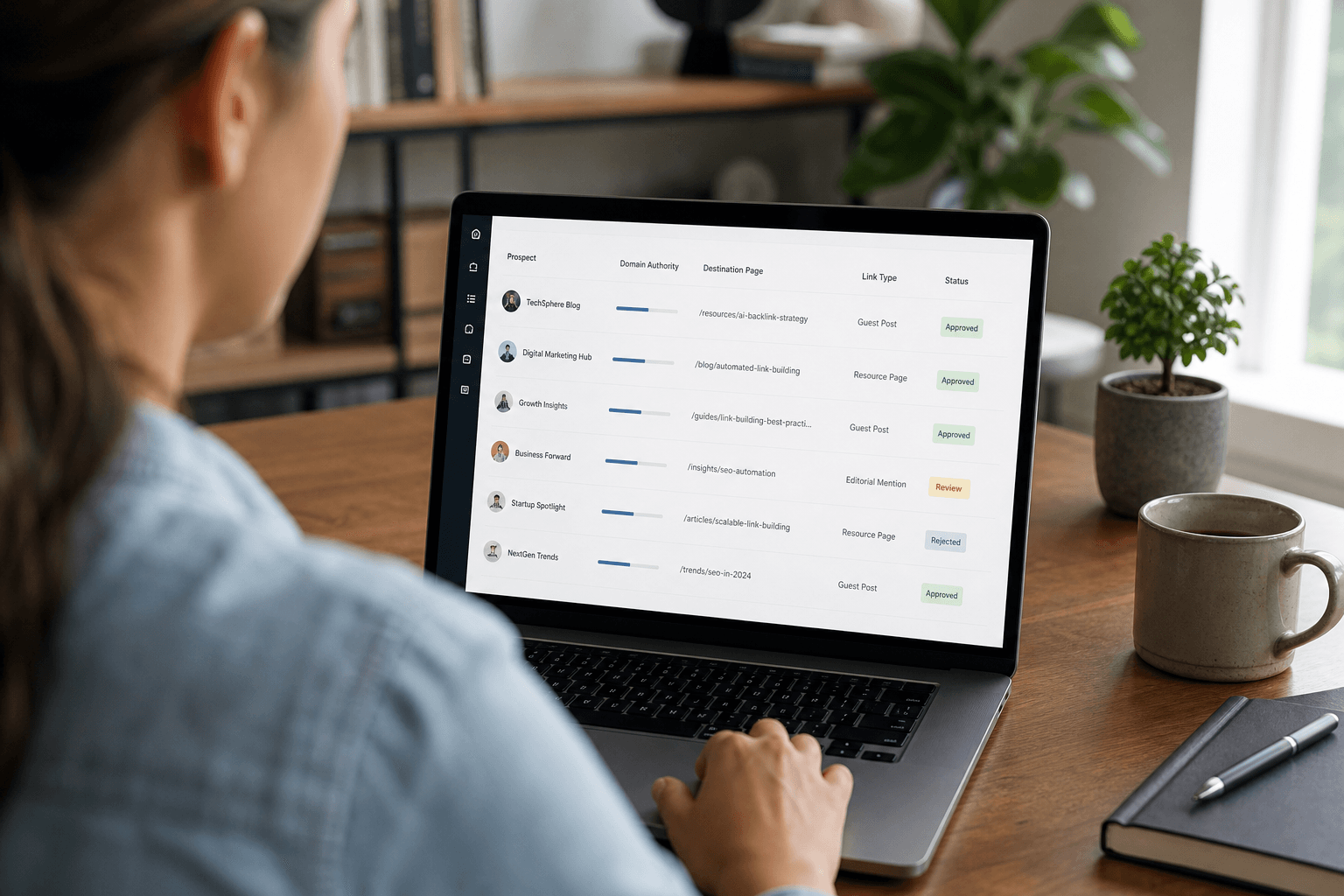
Teams comparing automation options can use backlink management software to identify relevant sites, prioritize opportunities, and direct links to useful pages. The important feature is not automation alone, but whether the workflow makes its reasoning visible enough for review.
Compare three backlink-building approaches#
| Approach | Strengths | Limitations | Best fit |
|---|---|---|---|
| DIY manual outreach | Maximum control and direct relationship building | Slow research, inconsistent follow-up, and difficult reporting | Small campaigns with a narrow group of valuable prospects |
| Software-assisted automation | Faster discovery, organization, drafting, and monitoring | Someone must still review prospects and manage outreach | Owners or marketers who want leverage without surrendering judgment |
| Managed automation | Less internal effort and a repeatable process | Quality depends on sourcing transparency and review standards | Businesses that lack time but require clear controls |
Choose based on your bottleneck. If you already know which publications or organizations matter, manual relationship building may be enough. If research and follow-up consume the most time, software assistance can remove repetitive work. Managed automation is sensible only when the provider explains how prospects are sourced and how poor opportunities are rejected.
How to evaluate a backlink opportunity#
Do not approve a prospect because a tool assigns it a high score. Review the opportunity in the context of the page, the audience, and the proposed destination.
- Topical relevance: Does the site cover your industry, service, product category, or a closely related problem?
- Audience fit: Would its readers plausibly benefit from visiting your page?
- Page context: Is there a real article, resource, association page, or local guide where the link belongs naturally?
- Editorial legitimacy: Does the site publish genuine material, or does it mainly exist to sell or exchange links?
- Destination relevance: Does the link answer the reader’s need instead of automatically pointing to your homepage?
- Reader value: Would the link still make sense if search engines provided no ranking benefit?
Relevant mentions in useful articles are usually stronger opportunities than placements in large, unrelated lists, even when the latter advertise impressive metrics.
A controlled automated backlink-building workflow#
1. Audit existing links and mentions#
Identify sites that mention your business without linking, pages that already link to you, outdated links, and commercial pages receiving little external support. Existing relationships and relevant mentions are often more practical than a completely cold prospect list.
2. Build and qualify prospects#
Let software gather possible publications, local organizations, suppliers, partners, industry resources, and specialist blogs. Filter the list by topic, audience, publishing activity, and the presence of a plausible editorial reason for a link.
3. Prioritize opportunities#
Rank prospects by likely usefulness, not raw quantity. Record why each site is relevant and which page could serve its audience.
4. Choose the destination page#
Match the destination to the surrounding subject. A service page may fit a local provider list, while a detailed guide may fit an educational article. Avoid forcing every opportunity toward the homepage or repeating identical anchor text.
5. Draft, review, and send outreach#
Automation can prepare a first draft, but verify the recipient, publication, proposed resource, and factual claims. Outreach should suggest a useful contribution or correction, not imply that a site owes you a link.
6. Approve and monitor placements#
Before publication, check the final page, surrounding copy, destination, and link attributes where relevant. Monitor removals, redirects, hacked pages, or changes that make a link irrelevant.
Set goals using referring domains and the link gap#
A backlink is an individual link. A referring domain is a unique website linking to you. One site can produce many backlinks, but those links do not represent the same breadth of recommendation as links from several relevant domains.
Before setting automated backlink targets, calculate your link gap by comparing the referring domains behind pages already ranking. Review the top competing pages for the specific query, record their relevant referring domains, and compare those figures with the page you want to improve.
This is a planning aid, not a universal ranking formula. Competition, content quality, internal linking, brand strength, search intent, and technical accessibility also matter. Use the comparison to decide which pages deserve attention rather than promising a fixed number of links each month.
Risks and red flags in automated link building#
Automation is not automatically safe or unsafe. The risk depends on what the system does, why the links are created, and whether the placements are relevant and editorially defensible.
- Guaranteed link quantities without clear sourcing or quality standards.
- Unrelated websites, generic lists, or pages containing thousands of businesses.
- Mass-generated articles or sites designed mainly to host links.
- Opaque private networks or providers unwilling to show examples.
- Links aimed at manipulating rankings rather than helping an audience.
- Automatic placement on commercial pages with repetitive anchor text.
When assessing an automation platform, ask about backlink sourcing and whether its outreach produces editorial link placements rather than purely transactional links. A provider should explain how prospects are found, what approval rights you have, and what happens when a placement is poor or becomes irrelevant.
Checklist for choosing automated backlink-building software#
- Can the platform show why each prospect is relevant?
- Can you approve prospects, outreach, destination pages, and final placements?
- Does it distinguish editorial opportunities from paid, exchanged, or directory placements?
- Can you control promoted pages and avoid repetitive anchors?
- Does reporting show referring domains, live URLs, destination pages, and link status?
- Can you export activity history and review removed or changed links?
- What is the remediation process for an irrelevant or unauthorized placement?
- Does the vendor avoid promising rankings, traffic, or fixed link quantities?
A platform that reduces research time but hides the underlying opportunities may leave you with less control, not more. The best workflow makes approval easier by presenting evidence and context at the point of decision.
Where UpliftAI fits in the workflow#
UpliftAI positions its backlink functionality around finding websites that already mention a business, identifying relevant sites that could recommend it, and directing links toward useful commercial or service pages. Its supplied backlink workflow distinguishes relevant local publications and blogs from random, unrelated link lists.
This fits the software-assisted model when a buyer wants research, prioritization, destination-page suggestions, and monitoring organized in one process. UpliftAI also describes its wider platform as an SEO execution engine that researches, writes, optimizes, and publishes content, with automatic backlink building among its capabilities. Those capabilities do not remove the need to review relevance and editorial legitimacy before approving a link.
Frequently asked questions#
Is automated backlink building safe for a small business website?#
It can be when automation supports legitimate research, outreach, and monitoring rather than mass link creation. Review every opportunity for relevance, audience value, editorial context, and a defensible reason for the link.
Which backlink-building tasks should remain manual?#
Keep final decisions about prospect relevance, outreach accuracy, destination pages, anchor context, placement approval, and risk review under human control.
How can I tell whether an automated opportunity is relevant?#
Ask whether the site serves an audience that could benefit from your page and whether the proposed link fits naturally within specific content. If the only rationale is that the site accepts links, reject it.
Should I measure backlinks or referring domains?#
Track both for diagnostics, but use referring domains for strategic comparison. A page-level link gap also helps you compare your target page with current search results.
What should I ask a backlink automation vendor?#
Ask how prospects are sourced, what approval controls exist, how destinations and anchors are selected, what reporting is provided, and how poor or removed placements are handled.
Conclusion: automate the process, not the judgment#
Automated backlink building is most useful when it removes repetitive work while preserving the decisions that protect quality. Automate discovery, organization, drafting, follow-up, and monitoring. Keep relevance, editorial legitimacy, destination-page selection, and final approval under deliberate control.
Set goals with referring domains and page-level competitive gaps, then judge progress by useful relationships and qualified visibility rather than an arbitrary link count. For businesses looking to combine backlink workflow support with broader automated SEO execution, visit UpliftAI to review its current platform offering.