

On this page
- Quick summary
- What SEO link building tools actually do
- Step 1: Choose the tool category that matches the job
- Step 2: Define the pages and outcomes worth supporting
- Step 3: Assess prospects for relevance and quality
- Step 4: Automate the repetitive work, not the judgment
- Step 5: Separate external backlinks from internal linking
- Step 6: Track opportunities, placements, and destination pages
- Safety limits for automated link building
- Step 7: Use a buyer checklist before choosing software
- A simple decision checklist for small businesses
- Frequently asked questions
- Conclusion: Choose the workflow you can review and sustain
The best SEO link building tools are not necessarily the ones that promise the most backlinks. The right choice depends on the work you need to complete: finding relevant prospects, organizing outreach, monitoring earned links, improving internal linking, or coordinating a broader SEO workflow.
For a small business, a useful tool should explain why an opportunity fits, connect each link to a worthwhile page, preserve human approval, and make it easy to track what happened. This guide walks through that decision in order, from defining the job to checking a platform before you commit.
Quick summary#

- Choose a tool category based on the job: prospecting, outreach, monitoring, internal linking, or broader SEO execution.
- Prioritize topical relevance, audience overlap, editorial context, and destination-page fit over arbitrary backlink counts.
- Automate research, organization, reminders, and monitoring, but review prospects, messages, claims, and placements yourself.
- Separate external backlinks, which require another site’s agreement, from internal links on your own website.
- Reject purchased links intended to manipulate rankings, generic mass outreach, and automation without quality controls.
What SEO link building tools actually do#
SEO link building tools support different parts of the backlink workflow. Backlink research can show who links to a site or a competing page. Prospecting tools help identify relevant websites. Outreach tools organize contacts and follow-ups, while backlink monitoring tools record whether an earned placement is live and where it points.
Internal linking is a separate activity. It connects pages within your own website, whereas an external backlink comes from another website and depends on that publisher agreeing to link to you. Google’s guidance on crawlable links is useful when checking whether links are implemented in a way search engines can discover and understand: Google’s crawlable link recommendations.
This distinction matters because a platform that is excellent at internal site architecture may not help with outreach, and a prospect database may not publish, monitor, or improve the pages receiving links.
Step 1: Choose the tool category that matches the job#

Start by naming the bottleneck. Do not buy an all-in-one platform simply because it has a long feature list, and do not use a specialist tool when the real problem is an unmaintained content and publishing process.
| Tool category | Best fit | What to check | Main limitation |
|---|---|---|---|
| Backlink research and prospecting | Finding relevant websites and link opportunities | Prospect rationale, filters, destination-page suggestions | May not support relationship management or monitoring |
| Outreach software | Managing contacts, messages, and follow-ups | Personalization, approval controls, response tracking | Cannot make an irrelevant opportunity valuable |
| Backlink monitoring | Tracking earned placements | Live status, target URL, anchor context, history | Usually does not create the opportunity |
| Internal-linking tools | Connecting related pages on your own site | Relevant suggestions, editable anchors, approval workflow | Does not replace external outreach |
| SEO automation platforms | Coordinating research, content, links, and publishing | Workflow coverage, CMS support, review gates, reporting | Requires careful configuration and oversight |
| Manual workflow | Small campaigns with highly specific relationships | Documented prospect criteria and a tracking sheet | Slow and difficult to scale consistently |
Choose the narrowest category that solves your current constraint. A broader platform becomes more attractive when your team is spending time switching between keyword research, content creation, internal linking, publishing, and backlink tracking rather than doing meaningful marketing work.
Step 2: Define the pages and outcomes worth supporting#
Before searching for prospects, identify the pages that deserve attention. These might include a service page, a location page, a product category, or an educational asset that genuinely helps prospective customers.
Write down why each page matters. A link to a useful local service page may support discovery by a nearby audience, while a link to a detailed resource may help another publisher explain a complicated topic. The destination should make sense to the reader who clicks, not just to the person reporting the backlink.
Set outcomes that are broader than link volume. You might track relevant referral visits, inquiries associated with a destination page, new relationships, improved discovery of important pages, or legitimate placements that remain live. Avoid assuming that every backlink produces a ranking improvement.
Step 3: Assess prospects for relevance and quality#
A strong prospect is not simply a site with a high authority score. It has a plausible connection to your topic, audience, location, or business relationship, and it can place the link in an editorial context that benefits its readers. UpliftAI describes its backlink management software in similar terms, including relevant prospects, the reason each site fits, and the page a link should support.
Use this checklist before adding a prospect to an outreach queue:
- Topical fit: Does the site regularly cover subjects related to your expertise, product, or service?
- Audience overlap: Would its readers plausibly benefit from visiting your page?
- Local connection: For a local business, is there a genuine geographic, community, supplier, or event relationship?
- Editorial context: Is there a real article, resource, directory, or partnership page where the link would be useful?
- Destination fit: Does your proposed page answer the need created by the surrounding content?
- Site quality: Does the website appear maintained, specific, and written for people rather than assembled mainly for links?
- Relationship potential: Is there a reason to contact the publisher beyond requesting a link?
Be cautious when a tool presents thousands of identical prospects, offers no explanation for its recommendations, or encourages links from unrelated sites. Google’s spam policies provide the appropriate safety reference for practices intended to manipulate search visibility.
Step 4: Automate the repetitive work, not the judgment#
Automation can reduce administrative work. It can help discover prospects, organize them by topic or location, enrich contact records, draft outreach from approved information, schedule reminders, monitor mentions, and record placement status.
Human review still belongs at the points where context and reputation matter. Review whether the prospect is genuinely relevant, whether the proposed page is useful, whether the message is personalized, whether claims are accurate, and whether the placement is editorially appropriate. A practical quality-first link building process combines software assistance with relevant prospects, useful assets, personalized outreach, human review, and placement tracking.
Use stop points in the workflow. Do not let a tool automatically send every draft, publish claims it has not verified, or approve placements simply because a numerical metric looks attractive. The other website still decides whether a backlink is earned.
Step 5: Separate external backlinks from internal linking#
Internal links are controlled by your team. They connect related pages, guide visitors toward useful next steps, and help clarify how your content fits together. External backlinks are recommendations from other websites and require a separate prospecting and relationship process.
An auto linking tool can be useful when a site has many pages and the team struggles to find sensible connections. UpliftAI’s described workflow reads pages and drafts, suggests anchor text and destination pages, and waits for approval before changes are made. That approval step is important because an automatically suggested link can still be irrelevant, repetitive, or poorly placed.
Use internal linking to strengthen the customer journey between related resources and commercial pages. Do not count those links as a substitute for external relationship building, and do not assume that adding links everywhere improves usability.
Step 6: Track opportunities, placements, and destination pages#
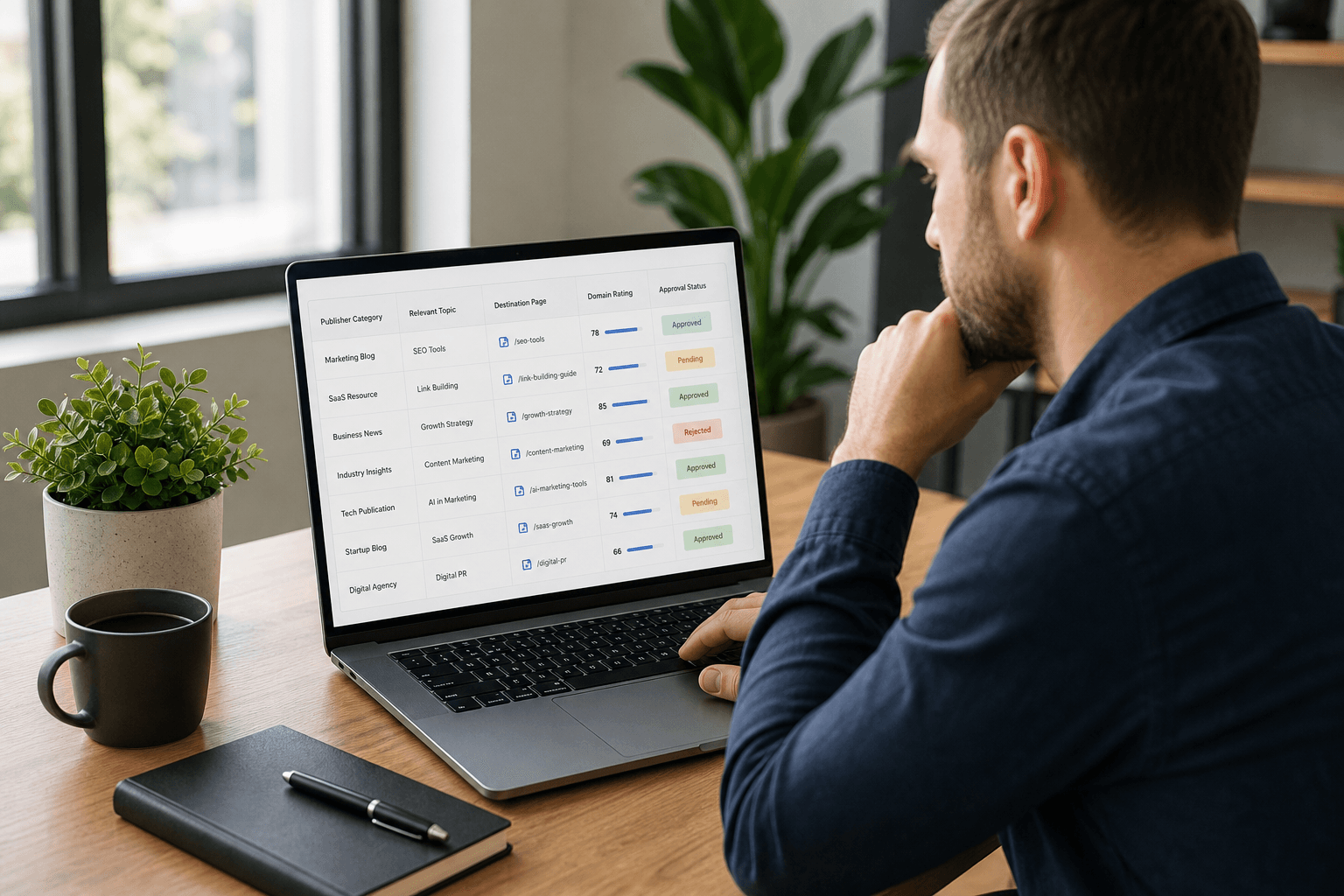
Backlink monitoring should record more than a total count. At minimum, keep a record of the prospect, the reason it was selected, the contact date, response status, live URL, linked destination, anchor context, and whether the placement remains available.
Connect every earned link to the page it supports. This makes it easier to see whether outreach is helping a service page, an informational asset, or a local resource, and it prevents the campaign from sending every link to the homepage.
Search Console can provide another view of links associated with a verified site. Its Links report documentation explains what the report shows and how to interpret it. Treat platform data and Search Console data as monitoring inputs, not as proof that a link caused a particular ranking or lead outcome.
Safety limits for automated link building#
A manageable process has clear boundaries. Avoid buying links for the purpose of manipulating rankings, submitting to irrelevant directories at scale, sending generic messages to large lists, publishing unreviewed claims, or chasing a fixed backlink target without regard to relevance.
Do not treat automation as risk-free. A tool can make an unsuitable process faster, which is why prospect criteria, approval gates, and periodic audits should be defined before a campaign runs. If you cannot explain why a link helps a real audience, pause the workflow and reassess it.
Step 7: Use a buyer checklist before choosing software#
Ask these questions during a trial or product review:
- Does the tool show how each prospect relates to my topic, audience, or location?
- Can I choose the destination page rather than sending every link to the homepage?
- Can I edit and approve outreach before it is sent?
- Does it distinguish prospect discovery, outreach, internal linking, and backlink monitoring?
- Can it record live URLs, placement context, response history, and lost links?
- Can I export my prospect and placement data if I change tools?
- Does it integrate with the CMS and workflow my team already uses?
- Are human review points visible, configurable, and easy to audit?
- Does it solve only link building, or does it also address content research, optimization, internal linking, and publishing?
If you want one system rather than several disconnected tools, compare the capabilities of an SEO automation platform, including its research, publishing, internal-linking, backlink, CMS, and reporting workflow. Make sure the broader feature set reduces operational work without removing the review controls your business needs.
A simple decision checklist for small businesses#
- Choose prospecting software when you have a clear offer and content, but need help finding relevant websites.
- Choose outreach software when prospect research is manageable but contact organization and follow-up are consuming time.
- Choose monitoring software when you already earn links and need a dependable record of live placements and destination pages.
- Choose an internal-linking tool when your site has useful content but visitors and search engines struggle to move between related pages.
- Choose a broader SEO automation platform when the main constraint is coordinating keyword research, content, optimization, internal links, publishing, and backlink activity.
- Keep the workflow mostly manual when opportunities are highly relationship-based, infrequent, or too sensitive for automated outreach.
Frequently asked questions#
Can SEO link building tools guarantee backlinks or higher rankings?#
No. A tool can identify opportunities, support outreach, and monitor placements, but another website must agree to publish an external link. Rankings depend on many factors, so no responsible platform can guarantee a particular result.
What is the difference between a backlink tool and an internal-linking tool?#
A backlink tool supports links from external websites through activities such as prospecting, outreach, and monitoring. An internal-linking tool connects pages on your own website, where you control whether a suggested link is added.
Which link-building tasks should remain under human review?#
Review prospect relevance, editorial fit, outreach personalization, factual claims, destination pages, and the quality of every proposed placement. Automation is most useful for organizing and monitoring repetitive work, not for replacing judgment.
How can a small business identify a relevant backlink opportunity?#
Look for a genuine connection among the publisher, its audience, your subject, and the page you want to support. A local, topical, partner, supplier, event, or educational relationship is usually more meaningful than an arbitrary metric.
What should backlink monitoring software track after a link is earned?#
Track the live page, linked destination, anchor context, relevance rationale, publication date, outreach history, and whether the link remains live. Also record referral or business signals when your analytics setup can connect them reliably.
Conclusion: Choose the workflow you can review and sustain#
The strongest SEO link building tools help with a defined job. They make relevant prospects easier to find, outreach easier to organize, earned links easier to monitor, or internal site connections easier to manage. They do not make irrelevant links valuable, force publishers to say yes, or turn backlink volume into a dependable outcome.
For most small businesses, the sensible choice is the workflow that explains its recommendations, supports useful destination pages, keeps human approval in place, and provides a clear record of what was earned. Start with one link-building constraint, test the process against your quality checklist, and expand only when the controls are working.
UpliftAI provides an AI-powered SEO workflow that supports keyword research, content creation, optimization, publishing, internal linking, and backlink activity. To review how UpliftAI fits your broader SEO process, visit its website.